
Be Her™
Female Founders, Advocates & Creative Leaders
Behind the Vision
Behind every business is a woman with a vision of her own. Peninsula Magazine is a female-owned publication with an all-female leadership team, and Be Her™ is our column created for open conversations with women in business. It celebrates female founders, advocates, and creative leaders who are building businesses, shaping culture, and defining success on their own terms.
Be Her™ will host pop up events and dinners around the country, celebrating women who are shaping our culture. We will partner with sponsors who share our values and support female founders through meaningful, in person connections. We are starting in Charleston to honor the city where Peninsula Magazine began. Our first event is coming this February.

Defining Success
Through intimate interviews and thoughtful storytelling, we explore the women behind the work, from the first spark of an idea to the decisions, risks, and defining moments that brought it to life. Beyond the finished product, Be Her looks at the person behind it all: her inspiration, ambition, and business philosophy.

The Narrative
Be Her is changing the narrative that asks women to choose one identity, one title, one box. Her work doesn't fit in one, and neither does she. From independent businesses to established entrepreneurs, we offer a closer look at the women shaping what comes next. Her work. Her perspective. Her influence.
BE Her
Nikki Gal | Beyond the First Impression
BE Her™ is Peninsula Magazine’s series celebrating female founders shaping our culture: women whose businesses, ideas, and creative pursuits influence the world beyond their industries. Nikki Gal’s career spans entrepreneurship, mental health advocacy, photography, and visual art. Having founded five creative companies, she has built a body of work that crosses disciplines, with a particular interest in women’s experiences, creative independence, and the conversations that shape how we understand ourselves. For BE Her™, we speak with Nikki about the thinking behind her businesses, the freedom to build beyond a single professional identity, and what it means to create work that lives beyond personal ambition.
Interview by Christina Coscia

Christina Coscia: 1. You have founded five creative companies, each rooted in a different expression of your interests. What did you see that you felt compelled to build?
Nikki Gal: I saw opportunities to create things that reflected parts of myself that didn’t necessarily have a place within the industries I was working in. Fashion, art, entrepreneurship and advocacy have always felt interconnected to me, even when they are treated as separate fields. I wanted to build platforms that could exist beyond a single product or professional identity. Each company has emerged from a different interest, but there is a common thread: the desire to create something with intention, independence and a point of view. I have never been particularly interested in building something simply because there was a market for it. I want to understand why something should exist, what it can contribute and how it might create opportunities for other people as well as myself.
Christina Coscia: 2. I’m curious about the point at which an idea becomes more than a personal interest and begins to take shape as a business. Did you recognize a gap in the market, a conversation that was missing, or an opportunity to bring together things that had previously existed separately? What determines which ideas are worth committing yourself to?
Nikki Gal: For me, an idea begins to become a business when I can see a way to translate a personal belief into something tangible that serves a purpose beyond myself. Sometimes that comes from recognizing a gap in the market; other times, it comes from noticing that a conversation is missing or that two seemingly unrelated disciplines could create something more meaningful together. I tend to begin with curiosity, but curiosity alone is not enough to run a business. I ask myself whether the idea has a clear purpose, whether I can contribute something distinctive to it and whether there is a meaningful reason for it to exist. I have learned that not every good idea needs to become a company. The ones worth pursuing are those that continue to resonate with you after you have examined them practically. Passion may introduce you to an idea, but clarity, discipline and a willingness to take responsibility for it are what allow you to build something lasting.
Christina Coscia: 3. There is a particular kind of freedom in building a career that doesn’t follow a prescribed path. How have you approached that freedom?
Nikki Gal: I have approached it by accepting that I am not obligated to remain within the boundaries of the identity people first associate with me. My career has moved through modeling, entrepreneurship, photography, visual art, and advocacy, and each field has given me a different way of understanding the world and expressing what matters to me. That freedom also requires a certain level of self trust. When you step outside an established path, you have to develop your own criteria for progress. For me, independence means having the freedom to evolve without feeling that I need to justify every change in direction. I would rather build a career that reflects who I am becoming than preserve an identity simply because it is familiar to other people.

Christina Coscia: 4. Your work spans entrepreneurship, photography, visual art, and advocacy. Rather than allowing one discipline to define the others, you have made room for several. How do you decide when to pursue a new direction, and how do you balance the instinct to explore with the discipline required to build something enduring?
Nikki Gal: I look for a genuine connection between an idea and the larger body of work I want to create. I am naturally curious, and I have never believed that creativity should be confined to one medium. Photography can inform my approach to fashion; fashion can become motivation for advocacy; and entrepreneurship can provide the structure that allows an artistic idea to reach people. I also believe that creativity needs structure. An idea may begin intuitively, but building a company requires planning, consistency and the ability to make decisions. I have learned to give myself room to explore while remaining conscious of what I have committed to building. Not every interest needs to become a business, and not every opportunity deserves a yes. Having insight is just as important as ambition.
Christina Coscia: 5. Women are often encouraged to establish credibility within one role, while men are more readily afforded the latitude to move between identities and industries. Have you encountered that distinction in your own experience as a founder?
Nikki Gal: I have experienced the limitations that come with being recognized primarily through one aspect of your identity. Once people have decided what category you belong in, there can be an expectation that you remain there, even when your work has developed far beyond it. As a founder, I have had to be intentional about allowing my work to speak for itself while refusing to accept that one professional title determines the limits of my capabilities. I would like to see women afforded the same freedom to be multi-faceted without every new venture being treated as something they must prove they are qualified to attempt.
Christina Coscia: 6. I’m interested in how women navigate the expectations attached to professional identity, particularly when their ambitions extend beyond the work for which they are initially recognized. Has building your own companies changed the way you think about authority, ownership, or the need to prove yourself?
Nikki Gal: Building my own companies has taught me that authority does not have to come from someone else granting you permission. It can come from taking responsibility for an idea, developing the skills to execute it and being willing to stand behind the decisions you make. Ownership has been especially important to me because it allows me to retain a degree of independence over my creative direction and the work I produce. I value collaboration, but I also believe it is important to understand what you are contributing, what you are entitled to retain and how the value of your work is being recognized. I have also become more selective about where I feel the need to prove myself. There is a difference between demonstrating your capabilities and continually defending your right to have ambitions. I no longer believe that every person needs to understand every aspect of what I do before I am entitled to pursue it. Over time, I have come to see self definition as an important part of independence: knowing what you bring to the table without allowing someone else’s perception of you and your work to determine your potential.
Christina Coscia: 7. Your advocacy work explores women’s mental health through art, fashion, and open conversation. What can creative platforms accomplish that traditional advocacy sometimes cannot?
Nikki Gal: Creative platforms can make difficult subjects feel more accessible without diminishing their complexity. Art, fashion and visual concepts can communicate emotions that people may struggle to articulate, creating an entry point for conversations that might otherwise feel intimidating or inaccessible. Mental health is often discussed through clinical terminology or statistics. Those approaches are important, but there is also value in creating spaces where people can recognize themselves in another person’s experience. Sometimes a photograph, an art work, or an honest conversation can help someone feel less isolated before they are ready to speak openly about what they are experiencing. Through my advocacy projects such as Raw Talk with Nikki Gal, The Model Memo with Nikki Gal and State of a Woman, I have been interested in creating opportunities for women to express themselves beyond the expectations placed on them. I see creativity as a bridge between personal experience and a united form of understanding. I do not believe art replaces professional mental health care. Rather, it can complement those efforts by reaching people emotionally, challenging the narratives they have internalized and encouraging them to approach these conversations with greater openness and empathy.
Christina Coscia: 8. Projects such as State of a Woman, #MORETHAN, and Mind Over Face bring personal experiences into a public conversation. How do you approach the responsibility of representing issues that are deeply personal to so many women? And how do you preserve the integrity of a message when you are also working within industries shaped by image, visibility, and commercial interests?
Nikki Gal: I approach this work with the understanding that personal experiences can be shared, but they cannot be used to define the experiences of every woman. There is a responsibility to create space for different perspectives rather than suggesting that one person’s story represents an entire community. For me, the integrity of these projects depends on intention. I want the work to encourage honest conversation, challenge restrictive expectations and remind women that their identities are not limited to how they look, how they work or how others perceive them. Working within fashion has made me particularly conscious of the contradictions that can arise when discussing mental health and identity in industries that place considerable emphasis on appearance. I do not think we need to reject visual culture to challenge its limitations. Instead, we can use creative platforms to question the messages they communicate and the standards they reinforce. Commercial interests will always exist, but they should not determine the meaning of the work. I want the message to remain meaningful even when the campaign, the publication or the immediate moment of visibility has passed. If a project encourages someone to reconsider how they see themselves or makes them feel less alone, that matters far more to me than the attention it receives.

Christina Coscia: 9. We tend to introduce women by the first thing the world came to know about them. Yet that introduction can become a limitation in itself. You are an entrepreneur, advocate, photographer, and, lastly, model. I think there is something important in that distinction: a woman’s appearance or first professional title should not take precedence over her ideas, her work, or what she builds. How have you navigated the relationship between public perception and professional substance, and what do you think needs to change in the way women are presented and understood?
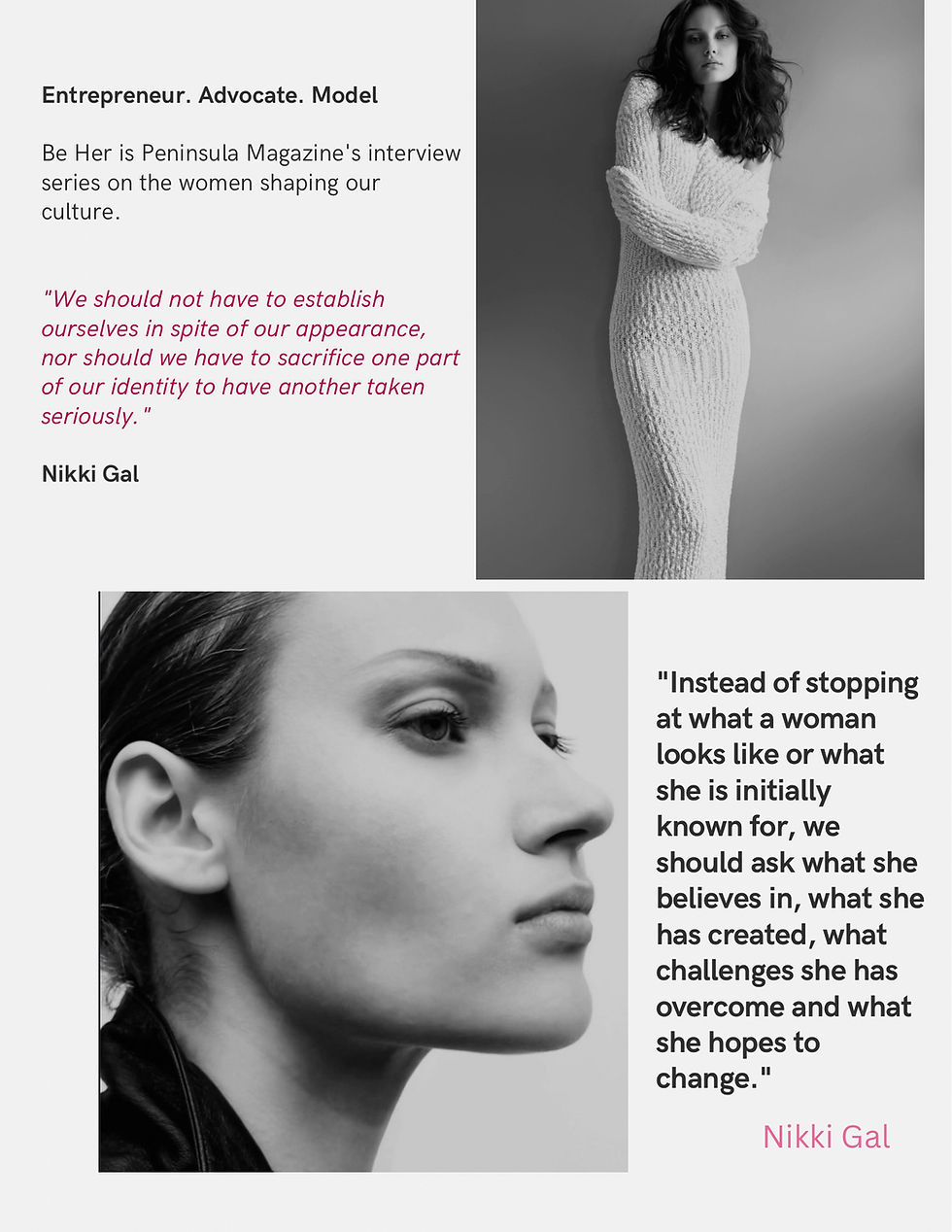
Nikki Gal: I think one of the greatest challenges I have navigated throughout my career is learning to separate how the world perceives me from the substance of who I am and what I have built. I entered the fashion industry at a young age, and naturally, my appearance became the first thing people associated with me. But being recognized for how you look and being understood for how you think are two very different things. Over the years, I have built businesses, developed creative projects, advocated for women’s mental health and explored photography as another form of artistic expression. These endeavors have allowed me to establish an identity that extends far beyond the initial introduction people had to me. I have never wanted to be confined to a single title, because I have never viewed myself through the lens of just one profession. My interests, ambitions and ideas have always been multi-faceted. I have also learned that you cannot always control the narrative people create about you, but you can control what you choose to build beyond it. There is a certain freedom in allowing your work to speak for itself, even when it takes time for others to recognize the person behind the image. I am less interested in correcting every perception than I am in continuing to create work that reflects the full scope of who I am. I believe the way women are presented in the media needs to evolve from introducing them through their appearance to understanding them through their contributions. We should not have to establish ourselves in spite of our appearance, nor should we have to sacrifice one part of our identity to have another taken seriously. I would also like to see more curiosity in the way we tell women’s stories. Instead of stopping at what a woman looks like or what she is initially known for, we should ask what she believes in, what she has created, what challenges she has overcome and what she hopes to change. There are entire dimensions of a woman’s life that remain unseen when we reduce her to a single image or title.
Christina Coscia: 10. When you consider the companies and creative platforms you have built, what do you hope exists because you decided to build them?
Nikki Gal: I hope they create possibilities that might not otherwise have existed. That could mean a woman finding a platform through which she can tell her story, a creative discovering a new way to approach her work, or someone encountering a conversation that helps her feel less alone. Each of my companies has allowed me to explore a different interest, but I hope their impact extends beyond my own career. I want them to demonstrate that creative independence can be used to build something with both personal meaning and broader value. I also hope they encourage other women to take their ideas seriously. You do not have to wait for an established platform to recognize your potential before you begin creating something of your own. You can develop the concept, build the structure and determine the values that guide it. I hope these companies and platforms exist as evidence that creativity can be more than a form of self expression. It can be a way to create opportunities, challenge existing narratives and contribute something meaningful to the world around you. If the work continues to serve a purpose beyond the moment in which it was created, then I feel I have built something worth while.

Christina Coscia: 11. Success is often measured through growth, recognition, and commercial achievement. But there is another measure in the opportunities a business creates, the voices it brings into a conversation, and the women it enables to pursue something of their own. What does meaningful success look like to you now, and how has that definition evolved as your work has grown?
Nikki Gal: Earlier in my career, success was more closely associated with visible milestones: opportunities and the achievement of goals I had set for myself. Those things can be meaningful, and I am proud of the work I have accomplished, but my understanding of success has become more expansive. I now think about what a project makes possible, whose voices it brings forward and whether it creates something of lasting value. I am interested not only in what I can achieve independently, but also in the opportunities my work might create for others. I have also come to value the freedom to define success on my own terms. Growth does not always mean becoming bigger or more visible. Sometimes it means building more intentionally, protecting your creative independence or choosing work that aligns with your values rather than accepting every available opportunity. Meaningful success, to me, is the ability to create work that reflects what I believe in, sustain it with integrity and know that it has made a difference beyond my own achievements. I want to measure my career not only by what I have built, but by what those creations allow other people to imagine, express and build for themselves.